Executive Insights
- Solar Cycle 25 is currently in a high-activity phase as of February 2026.
- Sunspot AR4366 produced an X8.1 solar flare on Feb 1, 2026, the strongest of the year.
- Immediate R3 radio blackouts affected aviation and maritime signals in the Pacific.
- A geomagnetic storm forecast for Feb 5, 2026, could trigger auroras at mid-latitudes.
- The solar maximum may be exhibiting a ‘double peak,’ extending the period of high solar risk.
As Solar Cycle 25 reaches its zenith, the Sun has delivered a stark reminder of its power. In early February 2026, a massive active region designated AR4366 unleashed a barrage of high-intensity solar flares, culminating in a violent X8.1 eruption. This event, the strongest recorded in 2026 and one of the most significant of the entire solar cycle, has triggered widespread radio blackouts and put Earth’s magnetosphere on high alert for incoming Coronal Mass Ejections (CMEs).
The February 2026 Solar Surge
While solar physicists initially predicted the solar maximum to peak between late 2024 and 2025, activity in early 2026 demonstrates that the Sun is far from quiet. The current surge is driven by Active Region 4366 (AR4366), a sunspot complex more than 10 times the width of Earth.
Between February 1 and February 3, 2026, this volatile region produced a rapid-fire series of eruptions:
- X8.1 Flare: Peaked on Feb 1, causing immediate R3 (Strong) radio blackouts.
- X2.8 & X1.0 Flares: Follow-up eruptions that compounded ionospheric disturbances.
- M-Class Swarm: Over a dozen M-class flares were recorded in a 24-hour window, indicating a highly unstable "delta-class" magnetic field.
Comparison to Previous Major Events
| Date | Flare Class | Source Region | Impact |
|---|---|---|---|
| Feb 1, 2026 | X8.1 | AR4366 | R3 Radio Blackout, Inbound CME |
| Oct 3, 2024 | X9.0 | AR3842 | Major Geomagnetic Storm (G4) |
| May 14, 2024 | X8.7 | AR3664 | Historic Aurora Event |
Coronal Mass Ejections (CMEs) and Geomagnetic Storms
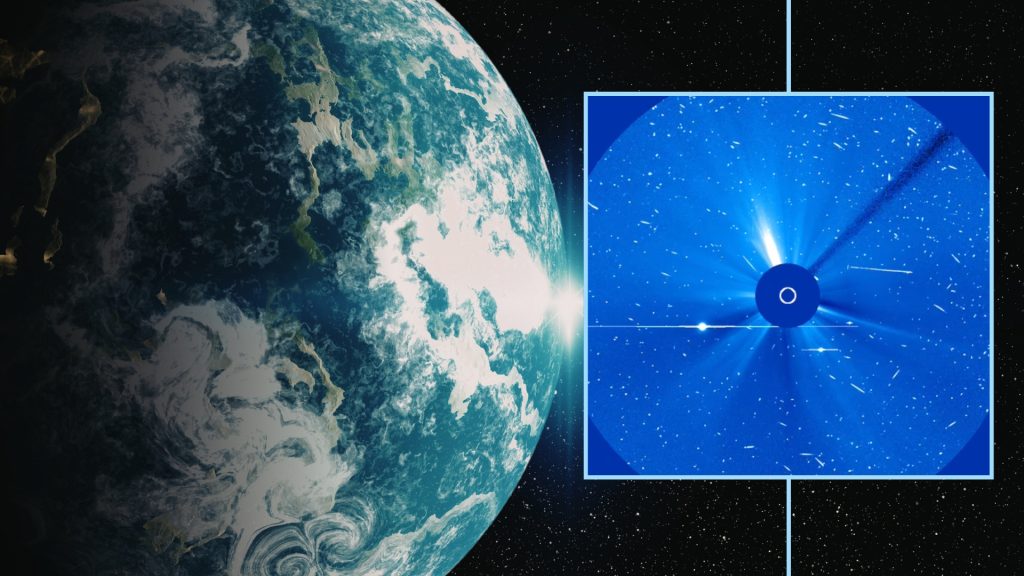
The immediate concern following an X-class flare is the potential for a Coronal Mass Ejection—a billion-ton cloud of solar plasma hurled into space. Data from the Solar Dynamics Observatory (SDO) confirms that the X8.1 explosion launched a CME with an Earth-directed component.
The Space Weather Prediction Center (SWPC) has issued a geomagnetic storm watch. While initial forecasts suggest a "glancing blow" leading to G1 (Minor) storms, the sheer energy of the X8.1 flare introduces the possibility of a more direct impact, potentially escalating to G3 (Strong) levels around February 5–6, 2026.
Understanding the "Cannibal CME" Effect
With multiple eruptions occurring in quick succession, there is a risk of a "Cannibal CME." This phenomenon occurs when a fast-moving CME overtakes a slower one launched earlier, merging into a single, massive wavefront. If the CMEs from the X1, X2, and X8 flares combine, the resulting geomagnetic storm could defy conservative forecasts, pushing auroras significantly further south than usual.
Technological Impacts: Radio Blackouts and Navigation
The electromagnetic radiation from the X8.1 flare reached Earth in just 8 minutes, ionizing the upper layers of the atmosphere. This caused an immediate Shortwave Radio Blackout across the sunlit side of Earth, specifically affecting:
- Aviation: Flights over the Pacific Ocean experienced temporary loss of HF radio contact.
- Maritime Operations: GPS signals were degraded for roughly 60 minutes following the peak.
- Ham Radio: Amateur radio operators reported a complete fade-out of signals below 30 MHz.
While these effects are temporary, they highlight the vulnerability of modern communication infrastructure during the solar maximum.
The Aurora Borealis Renaissance
One of the few positive side effects of this solar escalation is the expansion of the auroral oval. During typical solar minimums, the Northern Lights are confined to the Arctic Circle. However, the high-speed solar wind streams and CMEs associated with Solar Cycle 25 have repeatedly pushed displays into mid-latitudes.
If the incoming CME impact aligns with a southward-pointing interplanetary magnetic field (Bz), the aurora could be visible in early February 2026 across:
- North America: Northern US states (Michigan, Maine, Montana) and potentially as far south as Oregon or New York during peak storm conditions.
- Europe: Scotland, Scandinavia, and northern UK.
- Southern Hemisphere: Aurora Australis may be visible in Tasmania and New Zealand.
Future Outlook: Is this the Second Peak?
Solar Cycle 25 has defied early predictions of a "weak" cycle. The smoothed sunspot number peaked at 161 in late 2024, but the activity in early 2026 suggests a double-peaked maximum, a behavior often seen in energetic cycles. This means the threat of extreme space weather will persist through the remainder of 2026 before the cycle begins its slow decline toward the 2030 minimum.
In-Depth Q&A
Q: What is an X-class solar flare?
X-class flares are the most intense type of solar flare, capable of releasing energy equivalent to a billion hydrogen bombs. They are classified by a number (e.g., X1, X8), with each number representing a tenfold increase in intensity. An X8.1 flare is an extreme event capable of causing strong radio blackouts.
Q: Will the X8.1 flare hit Earth?
The electromagnetic radiation (flash) from the flare already hit Earth on February 1, 2026, causing radio blackouts. The associated Coronal Mass Ejection (CME)—the cloud of particles—is forecast to graze or hit Earth around February 5, potentially causing a geomagnetic storm.
Q: Is Solar Cycle 25 stronger than predicted?
Yes. Solar Cycle 25 has significantly outperformed initial forecasts from NOAA and NASA. While it was predicted to be a weak cycle similar to Cycle 24, sunspot numbers and flare intensity have rivaled stronger historical cycles, peaking higher and lasting longer.
Q: Can solar flares destroy the internet?
While a ‘solar apocalypse’ is unlikely, a direct hit from a massive CME (like a Carrington Event) could damage undersea cable repeaters and satellites, causing widespread internet and power grid disruptions. The current X8.1 flare is significant but not considered an existential threat to the global internet.
Q: Where can I see the aurora from this storm?
If the geomagnetic storm reaches G3 (Strong) levels, auroras may be visible in the northern United States (states like Washington, Michigan, New York) and the United Kingdom. Dark skies away from city lights are required for visibility.