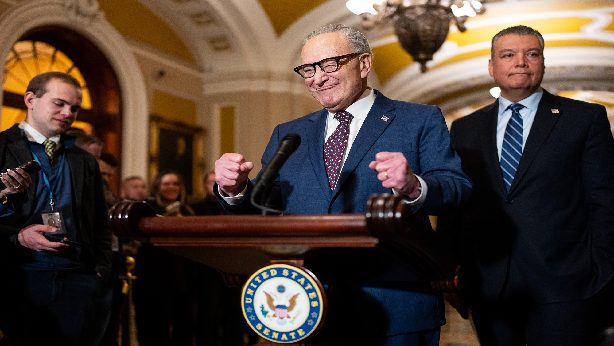
Executive Insights
- Chuck Schumer labeled the SAVE Act ‘Jim Crow style restrictions,’ claiming it is designed to suppress voters.
- The SAVE Act requires documentary proof of citizenship (e.g., passport, birth certificate) for federal voter registration.
- Critics argue Schumer’s rhetoric is hyperbolic, citing the failed ‘Jim Crow 2.0’ predictions regarding Georgia’s 2022 record turnout.
- Opponents claim the act would disenfranchise millions of citizens who lack ready access to citizenship documents.
- The bill is currently a sticking point in the February 2026 government shutdown negotiations between the House and Senate.
Analysis of the Safeguard American Voter Eligibility Act controversy, the resurgence of ‘Jim Crow’ narratives, and the statistical reality of past voter suppression claims.
Introduction: The Return of Heated Election Rhetoric
As of February 2026, Washington D.C. is embroiled in a tense legislative standoff that threatens to prolong a partial government shutdown. At the center of the conflict is the Safeguard American Voter Eligibility (SAVE) Act, a Republican-led measure requiring documentary proof of citizenship (DPOC) for federal voter registration. The political temperature spiked significantly this week after Senate Majority Leader Chuck Schumer branded the legislation as a return to “Jim Crow” segregationist policies, declaring the bill “dead on arrival” in the Senate.
Schumer’s comments have reignited a fierce debate not just about election integrity, but about the credibility of political rhetoric. Critics, including House Republicans and election integrity advocates, accuse the Majority Leader of deploying dangerous hyperbole. They point to similar dire predictions made about Georgia’s 2021 election reforms—labeled “Jim Crow 2.0” by Democratic leadership—which were subsequently followed by record-breaking voter turnout in the state. This article examines the details of the SAVE Act, the validity of the “voter suppression” claims, and the political ramifications of this rhetoric leading into the midterms.
What is the SAVE Act?
The Safeguard American Voter Eligibility Act aims to amend the National Voter Registration Act of 1993 (NVRA) to mandate that individuals provide documentary proof of U.S. citizenship when registering to vote in federal elections. Currently, federal law requires voters to swear they are citizens under penalty of perjury, but it does not strictly require physical proof (like a passport or birth certificate) at the point of registration in all states.
Key Provisions of the SAVE Act
| Provision | Details |
|---|---|
| Documentary Proof of Citizenship | Mandates that registrants provide specific ID (Passport, Birth Certificate, etc.) proving citizenship. Standard driver’s licenses may not suffice unless they are REAL ID compliant and explicitly denote citizenship status. |
| Voter Roll Maintenance | Requires states to establish programs to remove non-citizens from existing voter rolls. |
| Penalties | Establishes criminal penalties for election officials who knowingly register non-citizens. |
Proponents argue this is a common-sense safeguard to prevent non-citizen voting, citing concerns about border security and election integrity. Opponents, including the Biden-Harris administration and congressional Democrats, argue it creates unnecessary bureaucratic hurdles that will disenfranchise millions of eligible American citizens—particularly those who do not have ready access to their birth certificates or passports.
The ‘Jim Crow’ Controversy: Rhetoric vs. Reality
Senate Majority Leader Chuck Schumer’s characterization of the SAVE Act as “Jim Crow style restrictions” is a deliberate invocation of the segregationist laws that systematically disenfranchised Black Americans in the Jim Crow South. In a statement on X (formerly Twitter) and on the Senate floor, Schumer argued:
“The SAVE Act would impose Jim Crow style restrictions on voting… It is about suppressing voters. The SAVE Act seeks to disenfranchise millions of American citizens, seize control of our election, and fan the flames of election skepticism and denialism.”
The ‘Boy Who Cried Wolf’ Critique
Republican critics and political analysts have pushed back effectively by citing recent history. The primary counter-argument focuses on the disparity between previous Democratic predictions of voter suppression and the actual data from subsequent elections.
- The Georgia Case Study (SB 202): In 2021, Georgia passed the Election Integrity Act. President Biden called it “Jim Crow 2.0” and “Jim Crow on steroids,” a sentiment echoed by Schumer. Major League Baseball even moved the All-Star Game out of Atlanta in protest.
- The Result: Contrary to predictions of mass disenfranchisement, Georgia saw record turnout in the 2022 midterms. Data showed 0% of Black respondents reported a “poor” voting experience, and minority participation soared.
Senator Marsha Blackburn (R-Tenn.) and other GOP leaders have seized on this discrepancy, arguing that Schumer’s continued use of “Jim Crow” imagery is a “tired tactic” that no longer holds weight with the public because the doomsday scenarios failed to materialize. Critics argue that equating modern administrative requirements (like showing ID) with the violent, state-sponsored oppression of the actual Jim Crow era is a form of historical revisionism that trivializes the suffering of that period.
Analyzing the Arguments: Disenfranchisement vs. Integrity
Beyond the rhetoric, there are substantive policy disagreements regarding the SAVE Act.
The Argument for Election Integrity
Supporters emphasize that while non-citizen voting is illegal, current enforcement mechanisms are reactive rather than proactive. They argue that with high levels of illegal immigration, the potential for non-citizens to be inadvertently added to voter rolls (often through automatic registration at DMVs) is a valid national security concern. The SAVE Act, in their view, closes a loophole by verifying eligibility before registration occurs.
The Argument Against Bureaucratic Barriers
Opponents rely on data from organizations like the Brennan Center, which estimates that roughly 21 million American citizens do not have current, government-issued photo ID that proves citizenship readily available. They argue that requiring a birth certificate or passport to register would disproportionately affect:
- Women: Whose current legal names may differ from their birth certificates due to marriage or divorce.
- Young Voters: Who may not yet have passports.
- Minority & Low-Income Voters: Who are statistically less likely to possess these specific documents.
Schumer’s faction posits that the “cost” of preventing rare instances of non-citizen voting is the de facto suppression of millions of legitimate votes.
Political Fallout & The 2026 Standoff
The timing of this dispute is critical. As of February 2026, the SAVE Act has become a “poison pill” in negotiations to fund the Department of Homeland Security and end a partial government shutdown. House conservatives are refusing to pass spending bills without the SAVE Act attached, viewing it as a non-negotiable plank of 2026 election security.
Schumer’s refusal to bring the bill to the floor—labeling it “dead on arrival”—sets the stage for a prolonged stalemate. However, the efficacy of his “Jim Crow” messaging may be diminishing. With polling showing broad public support for voter ID measures (often exceeding 80% across demographic lines), Democrats risk being seen as obstructing popular election security measures, while Republicans risk being blamed for government dysfunction.
Ultimately, the controversy highlights a deepening divide: one side views the voting process as a sacred institution requiring strict verification, while the other views access as a fundamental right that should be as barrier-free as possible. The invocation of “Jim Crow” serves to energize the Democratic base but potentially alienates independent voters who see a disconnect between the rhetoric and the reality of voting in America today.
In-Depth Q&A
Q: What is the SAVE Act?
The Safeguard American Voter Eligibility (SAVE) Act is legislation proposed by Republicans that would require individuals to provide documentary proof of U.S. citizenship (such as a passport or birth certificate) when registering to vote in federal elections.
Q: Why did Chuck Schumer call the SAVE Act ‘Jim Crow’?
Schumer compared the SAVE Act to ‘Jim Crow’ laws because he argues the strict documentation requirements would disproportionately disenfranchise minority voters, the elderly, and young people, similar to how segregation-era laws were designed to prevent Black Americans from voting.
Q: What was the ‘Jim Crow 2.0’ controversy regarding Georgia?
In 2021, Democrats labeled Georgia’s election reform law (SB 202) ‘Jim Crow 2.0,’ predicting massive voter suppression. However, the subsequent 2022 elections saw record-breaking turnout in Georgia, leading critics to label the initial rhetoric as hyperbole.
Q: Do non-citizens vote in US elections?
Non-citizen voting is already illegal in federal elections. While rare, supporters of the SAVE Act argue that current registration loopholes allow it to happen and that proactive verification is needed to ensure election integrity.
Q: How does the SAVE Act affect government funding in 2026?
As of February 2026, House Republicans have attached the SAVE Act to government spending bills (specifically for DHS). Schumer has refused to consider the bill, leading to a standoff and a partial government shutdown.